
Cloud‑Native Solution
SAI Hardware Requirement

No Special Camera or Network Needs
White Labeled Alerts App
Information Security
Cloud‑Native Solution
Detailed view
SAI Group’s Visual AI platform is built as a cloud‑native solution, meaning that its full range of capabilities can operate seamlessly in the cloud, at the edge, or in a hybrid combination of both. This architectural approach allows retailers to deploy, scale, and manage visual intelligence workloads with maximum flexibility, performance, and resilience.
In practical terms, cloud‑native means that the same AI models, analytics pipelines, management tools, and security controls can run centrally on cloud infrastructure or locally on edge devices within retail stores. Retailers are not forced to choose between cloud or edge; instead, they gain the freedom to decide where each workload runs based on latency, bandwidth, privacy, and operational needs.
By adopting a cloud‑native design, the SAI Group Visual AI platform supports rapid innovation, elastic scalability, simplified operations, and consistent experiences across thousands of stores. It enables retailers to start small, expand quickly, and adapt continuously as business needs evolve—without redesigning their technology foundation.
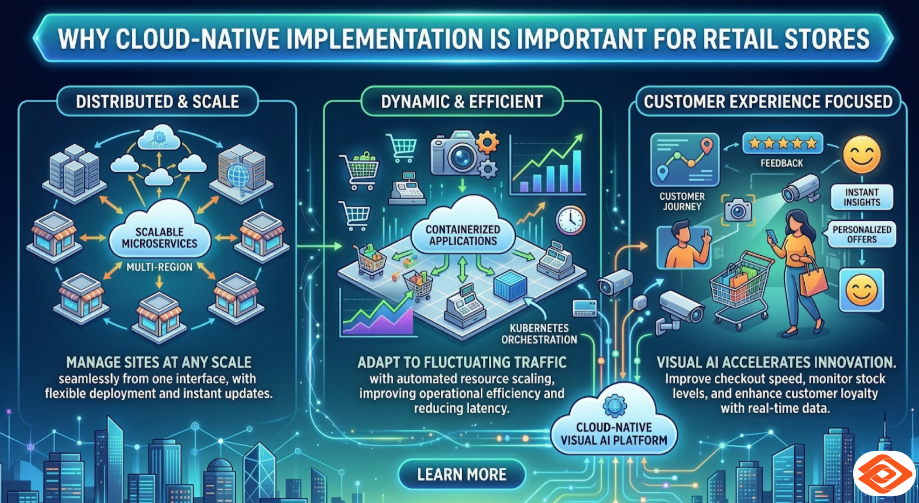
Why the Cloud‑Native Implementation Is Important for Retail Stores
Retail environments are uniquely complex. They are distributed, dynamic, and highly sensitive to customer experience. A cloud‑native visual AI platform directly addresses these realities.
First, retail stores are geographically distributed. Large retailers may operate hundreds or thousands of locations, each with different layouts, footfall patterns, and infrastructure maturity. A cloud‑native approach allows centralized control and governance while still supporting local execution at the store level.
Second, real‑time decision‑making is critical. Use cases such as loss prevention, shelf availability, queue monitoring, and safety compliance often require immediate responses. Running AI inference at the edge ensures low latency, while cloud connectivity enables advanced analytics, cross‑store insights, and continuous model improvement.
Third, retail workloads are highly variable. Peak hours, seasonal events, promotions, and new store openings create fluctuating demand. Cloud‑native systems can automatically scale resources up or down, ensuring performance without over‑provisioning hardware.
Finally, retailers must balance innovation with operational simplicity. Traditional, monolithic systems are slow to update and difficult to maintain across large estates. Cloud‑native platforms support frequent updates, remote management, and faster rollout of new features—reducing operational friction while accelerating innovation.
How the Cloud‑Native Implementation Works
The SAI Group Visual AI platform is designed using modern cloud‑native principles such as microservices, containerization, and API‑driven integration. These principles allow the platform to function consistently across cloud and edge environments.
At a high level, the platform consists of modular services responsible for video ingestion, AI inference, event detection, analytics, visualization, and system management. Each service can be independently deployed and scaled, whether in a central cloud environment or on edge compute devices within retail stores.
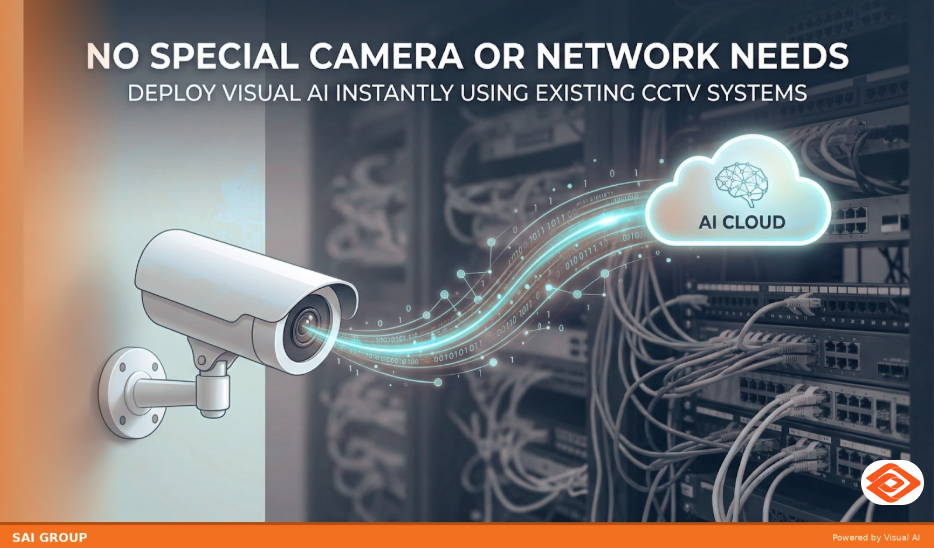
Edge deployment enables video streams to be processed locally, close to the cameras. This minimizes latency, reduces bandwidth consumption, and supports scenarios where connectivity may be intermittent. Critical insights—such as alerts or metadata—can then be securely transmitted to the cloud.
Cloud deployment provides centralized orchestration, long‑term data storage, advanced analytics, reporting, and cross‑store intelligence. Models can be trained, validated, and updated centrally, then securely distributed to edge locations without manual intervention.
A unified management layer ensures that policies, configurations, and updates are applied consistently across all environments. Whether a feature is running in the cloud or at the edge, it is governed by the same security, monitoring, and lifecycle management processes.
This hybrid, cloud‑native architecture ensures that retailers benefit from both centralized intelligence and localized performance—without fragmentation or duplication.
FAQ
Cloud‑native means the platform is designed from the ground up to run on cloud infrastructure while also supporting edge deployments using the same architecture, services, and management tools.
No. The platform supports cloud, edge, and hybrid deployments. Retailers can decide which functions run locally and which are centralized, without losing functionality.
Edge deployment is optional but recommended for use cases requiring real‑time responses or reduced bandwidth usage. The platform works equally well in cloud‑only scenarios.
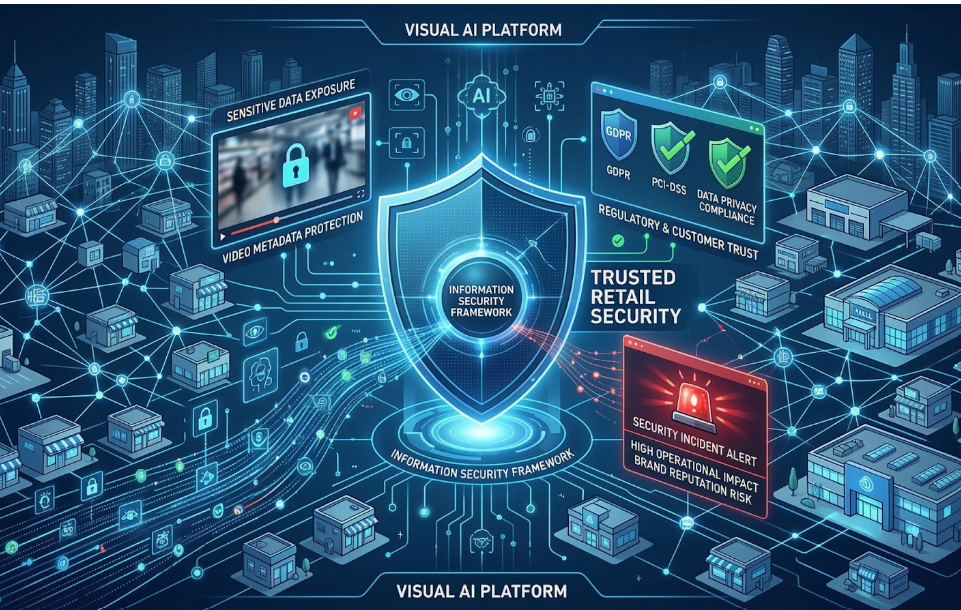
Security is built into the architecture, with encrypted communication, role‑based access control, and centralized policy enforcement across both cloud and edge environments.
Yes. The cloud‑native design allows the platform to scale horizontally across stores, cameras, and AI workloads without performance degradation.
Updates are managed centrally and deployed remotely, ensuring all stores stay aligned with the latest capabilities without manual intervention.