
Checkout Queue Time
Customers in Store Count
Average Time in Store
Customer Traffic Shape of Day
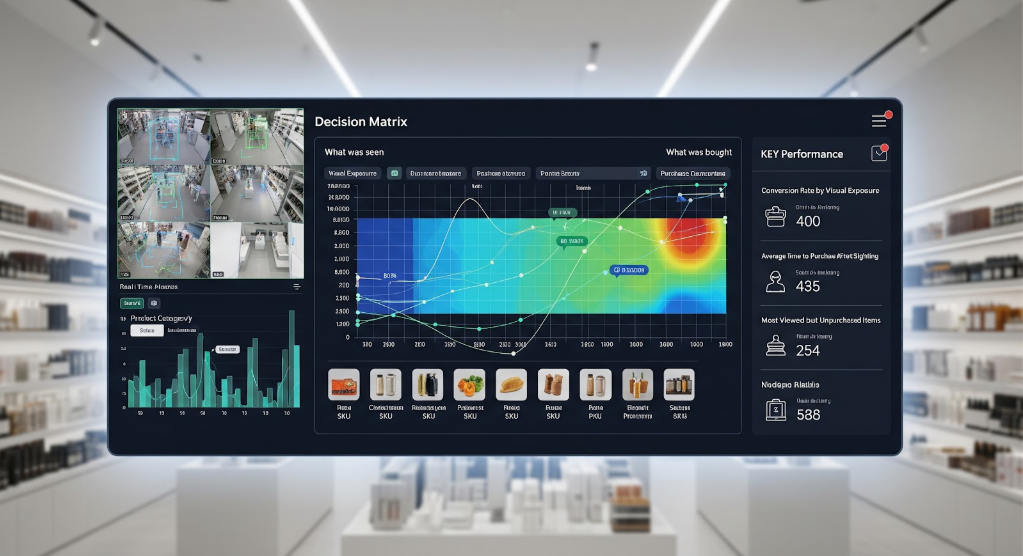
Decision Matrix
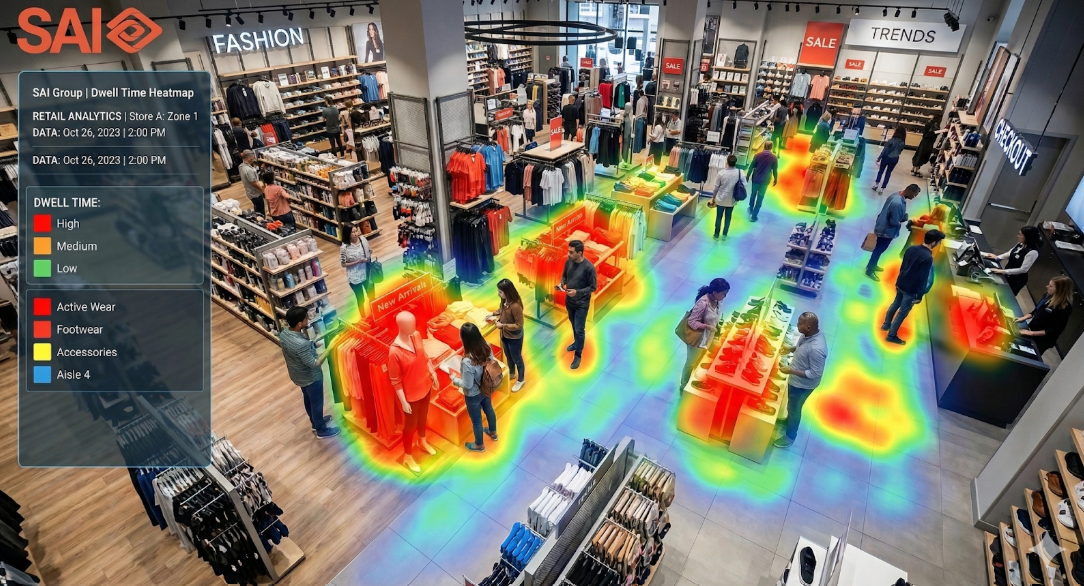
Dwell Time Heatmaps
Journey Statistics
Protect Changing Area

Service Alerts

Checkout Queue Time
Detailed view
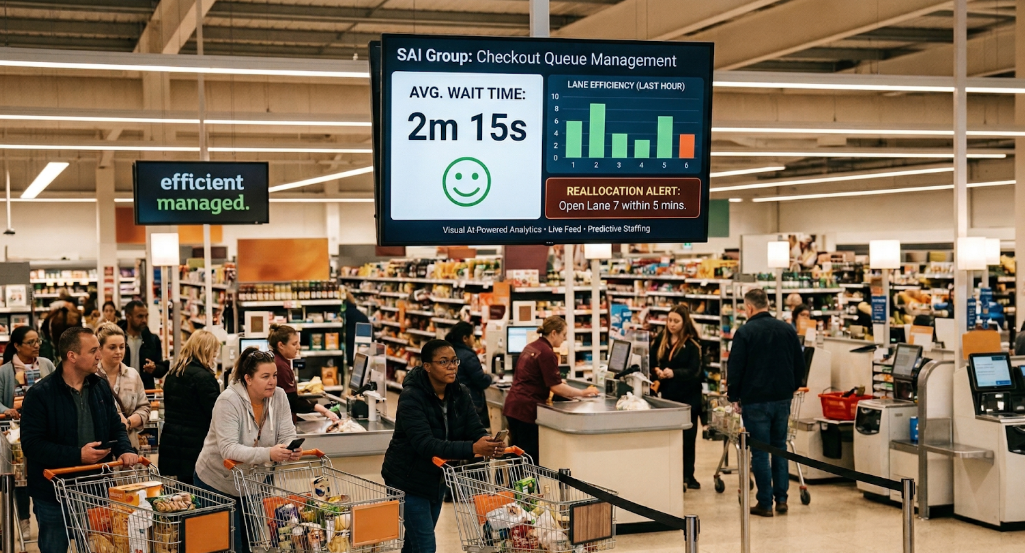
Checkout is the final and most emotionally charged moment of the in‑store shopping journey. Even when the rest of the experience is positive, long or unpredictable checkout queues can lead to customer frustration, abandoned purchases, and lost revenue. SAI Group’s Checkout Queue Time feature, part of its Visual AI–powered Queue Management capability, addresses this challenge by turning checkout congestion into a measurable, manageable, and actionable operational metric.
Powered by computer vision and advanced analytics, the feature continuously analyzes live video feeds from existing store cameras to understand queue conditions at assisted and self‑checkout lanes. It provides retailers with real‑time visibility into how long customers are waiting, how queues are forming, and when intervention is required. Instead of reacting to congestion after it becomes visible to shoppers, store teams can act earlier—opening counters, reallocating staff, or redirecting customers—to maintain consistent service levels.
By making checkout wait time transparent and predictable, SAI Group’s Checkout Queue Time feature helps retailers improve customer satisfaction, optimize labor utilization, and protect revenue at one of the most critical points in the store experience.
Why the Checkout Queue Time feature is important for retail stores
Queue congestion is not just an operational inconvenience—it has direct consequences for customer perception, loyalty, and store performance. From a shopper’s perspective, waiting in line is often the least enjoyable part of a store visit. Even short waits can feel excessive if queues appear disorganized or understaffed, increasing the likelihood of cart abandonment and reduced repeat visits.
From an operational standpoint, checkout queues indicate a mismatch between demand and capacity. Too few open lanes during peak periods result in congestion and lost sales, while opening too many lanes leads to inefficient labor usage and higher operating costs. Traditionally, managers rely on manual observation or staff intuition to judge when queues are “too long,” an approach that is subjective, inconsistent, and difficult to scale across multiple stores or locations.
SAI Group’s Visual AI approach changes this dynamic by allowing retailers to:
By transforming checkout queues into a data‑driven metric, retailers gain tighter control over one of the most revenue‑sensitive moments in the physical store journey.
How does the Checkout Queue Time feature work?
The Checkout Queue Time feature uses computer vision to interpret live video streams from existing cameras in the checkout area and convert them into actionable insights. The system is designed to adapt to different store layouts, checkout formats, and operational definitions of what constitutes a “queue”.
Flexible Queue Definitions
Different retailers define queues differently — Different retailers define queues differently—some focus on the number of people waiting at assisted checkouts, others on customers outside the belt area, or baskets building up near self‑checkout zones. The feature allows retailers to configure these definitions based on their store format and operational priorities.
Continuous Measurement of Wait Time
Once queues are defined, the Visual AI platform continuously monitors customer movement and checkout activity. It measures how long customers spend waiting, tracks queue growth and dissipation, and monitors checkout throughput in real time.
Real‑Time Visibility and Predictive Insights
Beyond reporting current conditions, the system analyzes flow patterns to anticipate congestion. By correlating store entry rates, checkout throughput, and queue buildup, the feature can indicate when additional counters should be opened to maintain desired service levels.
Unified View Across the Store
All insights are presented through a centralized view of queue health, giving managers a clear, real‑time understanding of checkout performance across lanes and time periods. This enables faster, more confident decision‑making during peak hours.
FAQ
The Checkout Queue Time feature can be configured for assisted checkouts, self‑checkout lanes, or mixed environments, depending on store layout and operational needs.
No. The feature is designed to work with existing in‑store camera infrastructure, reducing deployment complexity and cost.
Retailers can define what constitutes a queue based on their store format—for example, people waiting near belts, baskets accumulating, or customers standing outside a defined checkout zone.
It provides both real‑time visibility into current conditions and predictive insights that help managers anticipate congestion before it escalates.
Managers gain a clear, objective view of checkout performance, enabling faster decisions about opening lanes, reallocating staff, and maintaining service levels during busy periods.