Self-Checkout Theft Detection & Monitoring
Self‑Scan Theft Monitoring
Internal Fraud
.png)
Queue and Checkout Monitoring
Queue Management
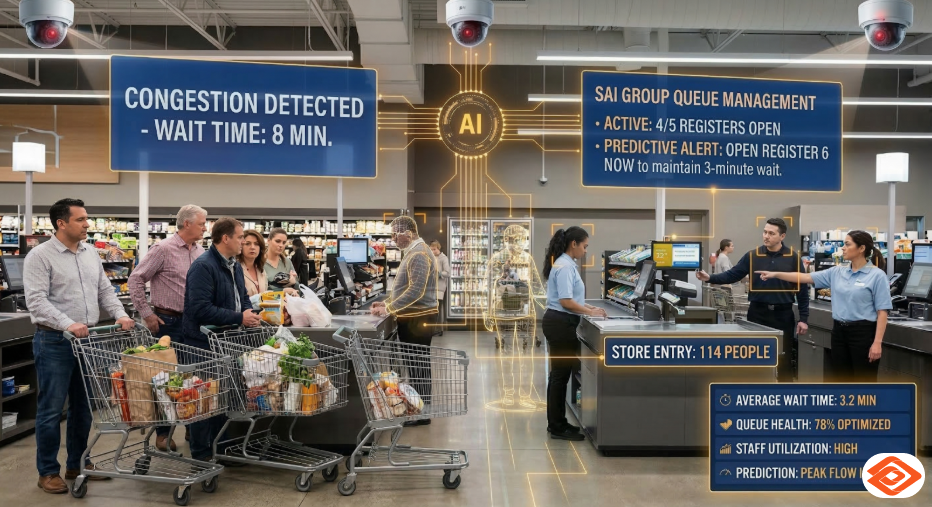
SCO Queue Availability Management
Assisted Checkout Monitoring
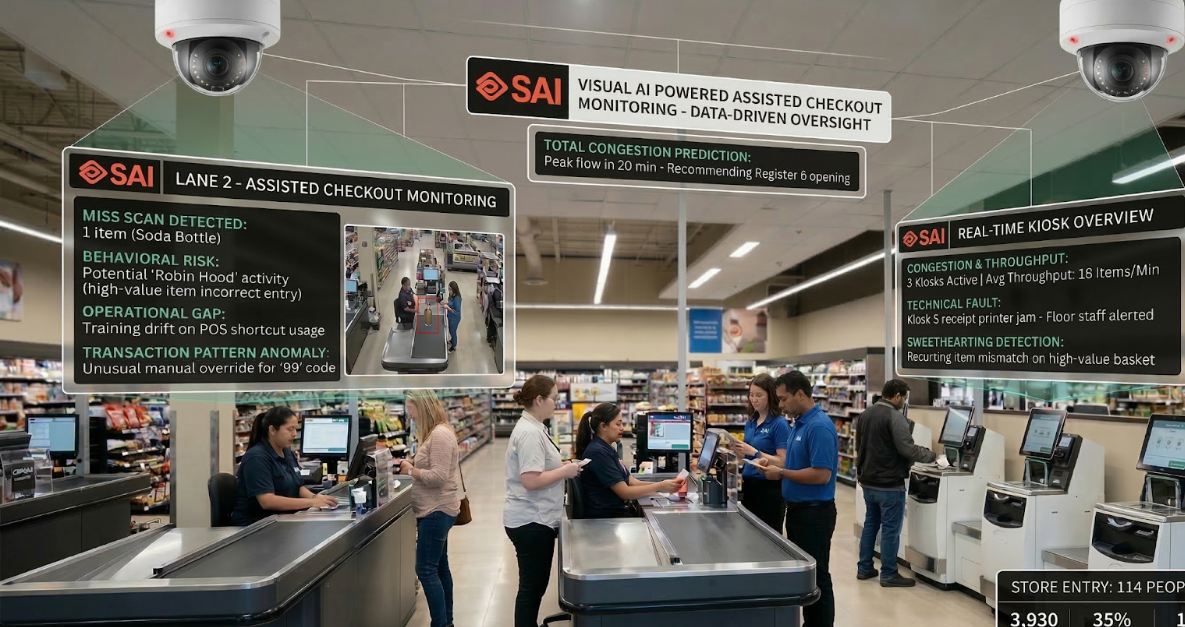
Self-Checkout Theft Detection & Monitoring
Detailed view
Self checkout theft and self service checkout theft are among the fastest-growing sources of retail shrinkage as SCO adoption increases across stores. SAI Group's Visual AI Platform is built to detect self checkout theft patterns in real time from missed scans and product switching to incomplete payments helping retailers prevent self service checkout theft before it impacts the bottom line.
Self-checkout (SCO) has become a cornerstone of modern retail, offering speed, convenience, and reduced staffing pressure. However, it also introduces new challenges—most notably revenue leakage due to unintentional errors and deliberate misuse. SAI Group’s Self-Checkout (SCO) Monitoring feature addresses these challenges using advanced visual AI to detect, nudge, and correct checkout issues in real time and offline modes.
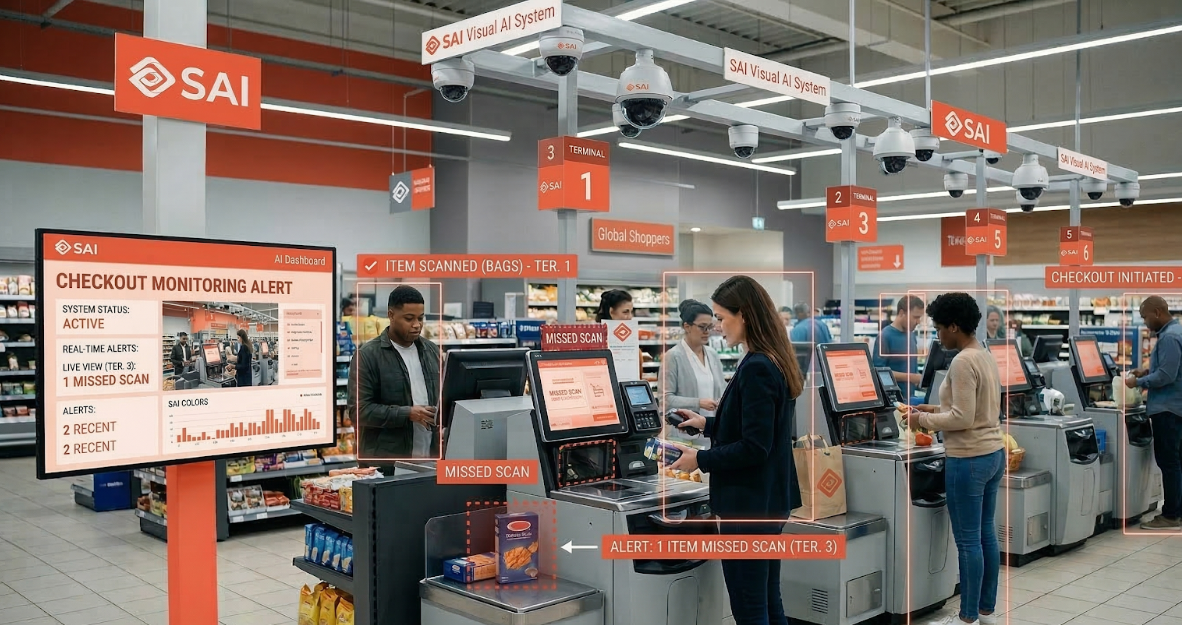
The SCO Monitoring feature continuously observes shopper interactions at self-checkout counters and identifies a wide range of loss-related and operational issues such as missed scans, product stacking, product switching, items in hand, items in basket, incomplete payments, and scenarios where multiple SCO terminals are covered by a single camera. Importantly, this is achieved without the need for GPU-based hardware, making the solution practical, cost-effective, and easy to deploy at scale.
A key differentiator of SAI Group’s approach is its focus on low-friction interventions. Rather than overwhelming shoppers or store staff with frequent alerts, the system uses a small number of intelligent nudges, delivered at the right moment. This results in over 90% self-correction, where shoppers correct the issue themselves without staff involvement. The platform also automatically reports whether each intervention was successful, providing retailers with clear, measurable outcomes powered entirely by vision AI.
Why the SCO Monitoring Feature Is Important for Retail Stores
As SCO adoption increases, retailers face a dual challenge: protecting revenue while preserving a positive customer experience. Traditional loss-prevention approaches—such as manual audits or constant staff oversight—are expensive, intrusive, and difficult to scale.
Key reasons why SCO monitoring is critical include:
Many losses at SCO are caused not by theft, but by honest mistakes such as missed scans or incomplete transactions. These errors are difficult to detect manually and accumulate quickly across stores.
Modern stores often deploy multiple SCO terminals close together, sometimes monitored by a single camera. This creates blind spots for conventional systems.
Overly aggressive alerts or frequent staff interventions frustrate customers and slow down checkout, undermining the very purpose of SCO.
SAI Group’s SCO Monitoring feature addresses these issues by providing continuous, automated oversight that is accurate, non-intrusive, and designed to correct issues at the source—while the transaction is still in progress.
How the SCO Monitoring Feature Works
The SCO Monitoring feature uses visual AI models trained to understand shopper behavior, product movement, and checkout workflows.
Continuous Visual Observation
Standard Analog/IP cameras installed above or near SCO zones feed video into SAI Group’s visual AI platform. The system tracks:
This allows a single camera to effectively monitor multiple SCO units simultaneously, without compromising accuracy.
Detection of Key SCO Use Cases
The platform detects and classifies a comprehensive set of SCO scenarios, including:
- • Missed Scan – An item is moved past the scanner without being scanned
- • Product Stacking – Multiple items scanned together as one
- • Product Switching – A cheaper item is scanned while a different item is bagged
- • Item in Hand – Shopper holds an item without scanning
- • Item in Basket – Items remain in the basket after scanning is complete
- • Incomplete Payment – The checkout flow is abandoned or payment is not completed
- • SCOs in One Camera – Accurate attribution of actions across adjacent SCO terminals
Live Nudging and Offline Review
- •Live nudging: When an issue is detected, the system triggers a subtle, contextual prompt (for example, an on-screen message or audio cue) encouraging the shopper to self-correct.
- •Offline monitoring: All events are logged for post-analysis, audits, and continuous improvement.
Crucially, the platform automatically determines whether the shopper corrected the issue after the nudge, using vision AI to confirm the outcome.
No GPU Requirement
The entire solution is designed to run efficiently on CPU-based edge devices, eliminating the need for costly GPUs. This makes the system:
- • Easier to deploy
- • Lower in total cost of ownership
- • More robust in real-world retail environments
FAQ
SAI Group's platform uses visual AI to continuously observe shopper behavior at self-checkout terminals. It identifies common self checkout theft patterns such as missed scans, product switching, and incomplete payments, then triggers a real-time nudge so staff can intervene before the customer leaves the store.
Self service checkout theft refers to revenue loss occurring at unattended or self-service checkout lanes, often through unintentional errors or deliberate misuse. SAI Group's solution prevents self service checkout theft by monitoring shopper actions across SCO terminals using standard cameras—no GPU hardware required—and delivering low-friction alerts that drive over 90% self-correction.
No. The solution works with standard analog/IP cameras and CPU-based edge devices, avoiding the need for GPUs.
Yes. The visual AI models are designed to spatially distinguish actions across multiple SCOs within a single camera view.
By using a small number of well-timed nudges instead of constant alerts. Most shoppers self-correct without staff involvement.
The event is logged, and retailers can decide whether to escalate through their existing store processes.
The platform automatically reports whether each intervention resulted in successful self-correction, providing measurable ROI.