
Queue Management
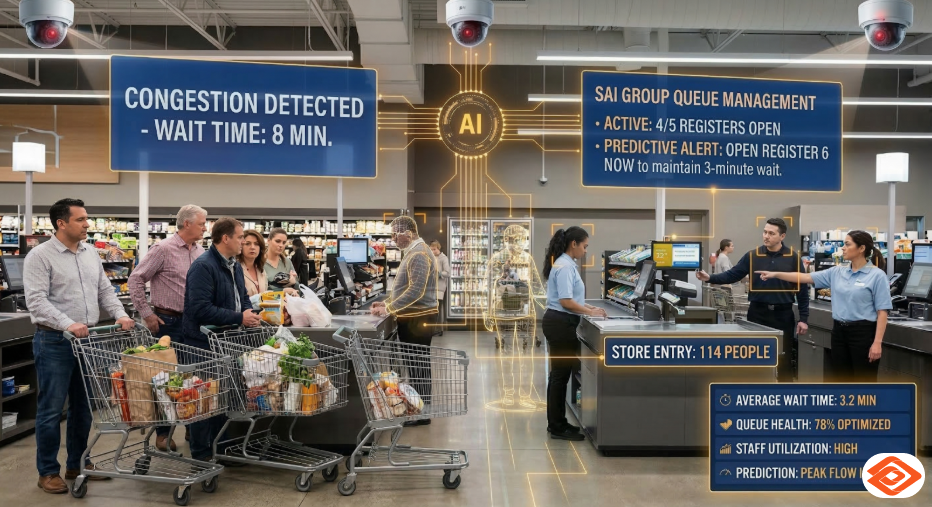
Queue and Checkout Monitoring
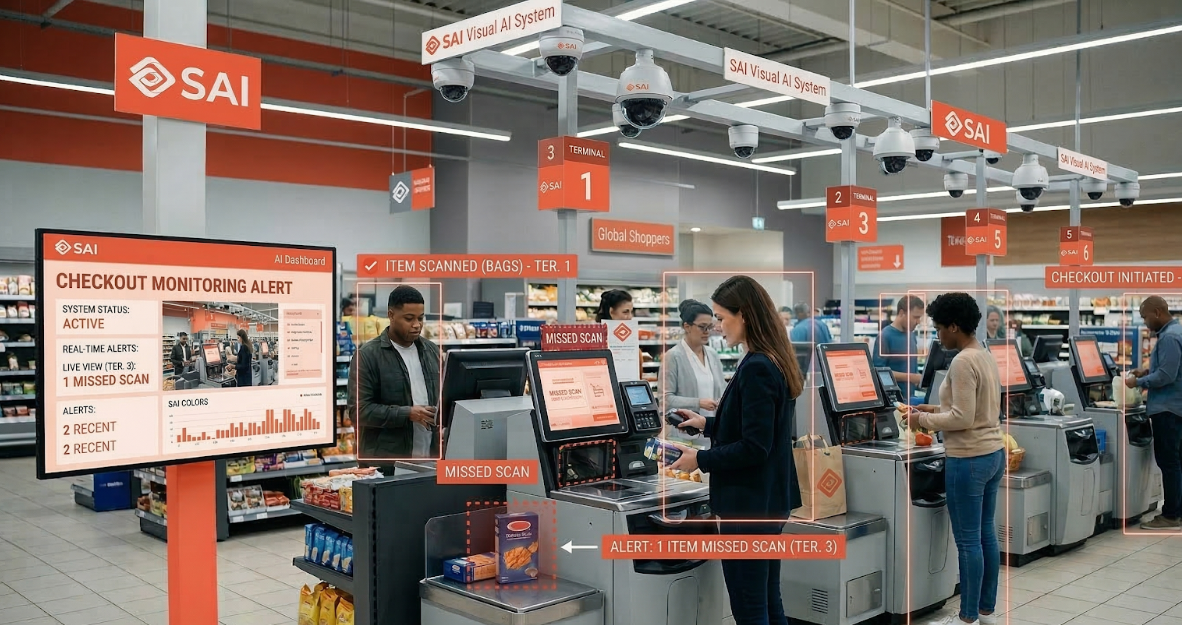
Self-Checkout (SCO) Monitoring
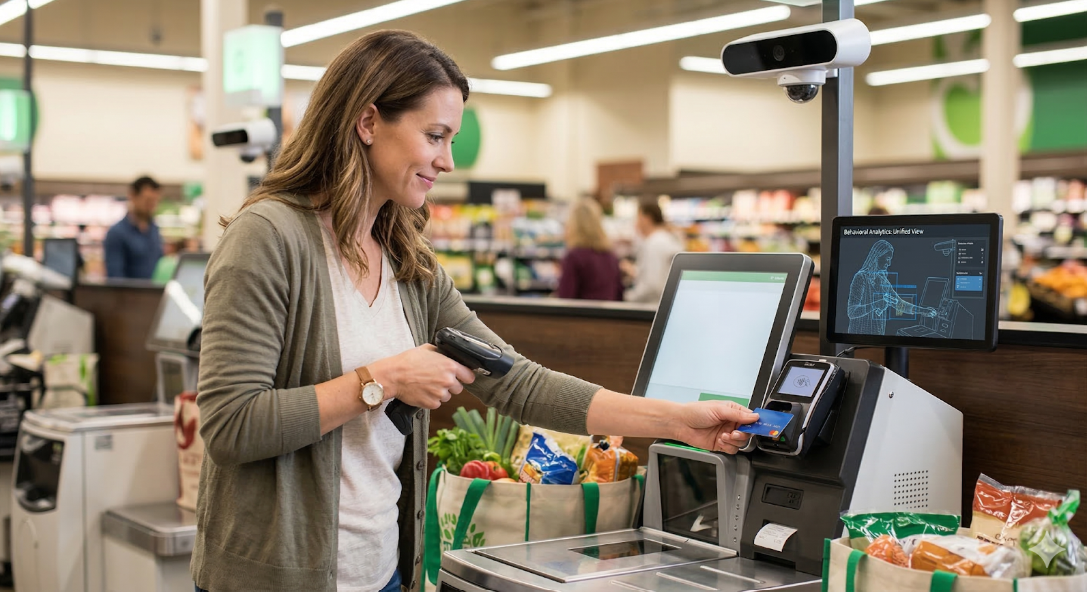
Self‑Scan Theft Monitoring
Internal Fraud
.png)
SCO Queue Availability Management
Assisted Checkout Monitoring
Stop List Replacememt

Beyond StopLift : How SAI Delivers Full-Checkout Loss Prevention Without Replacing a Single Camera or POS Terminal
The Checkout Loss Problem Most Platforms Don't Fully Solve
Checkout is where shrink is hardest to see and easiest to miss. Most detection platforms cover one or two loss vectors well and leave gaps in the rest. Those gaps are where loss compounds quietly over time.
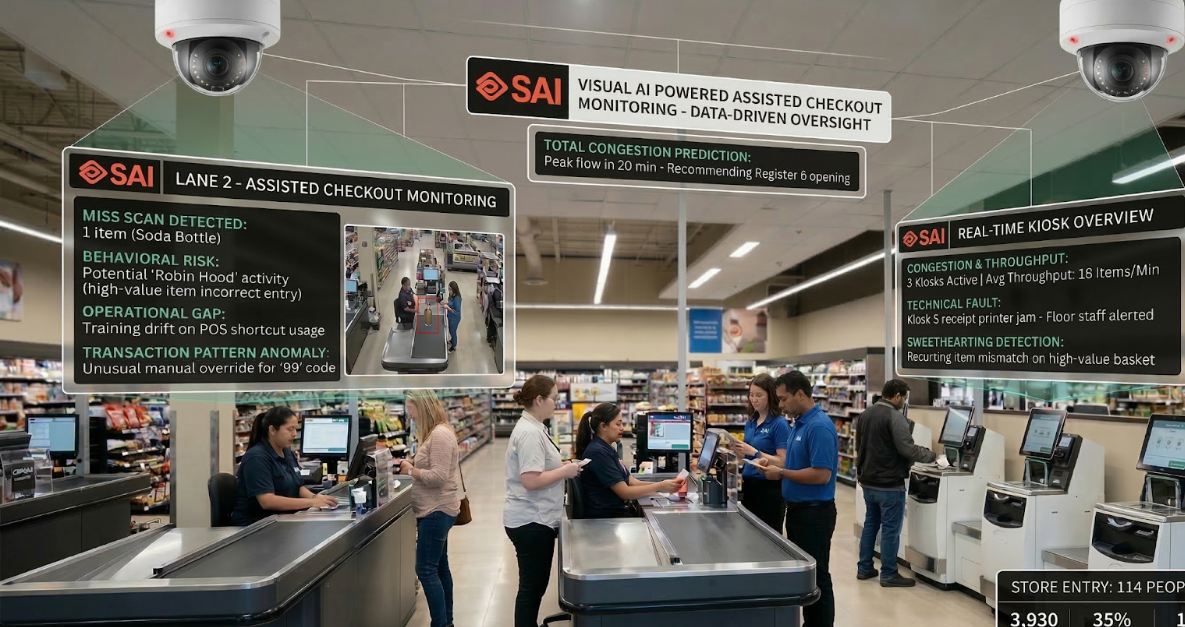
SAI monitors every transaction across every lane type, manned, self-checkout, and back-office, within a single platform. The same visual-to-POS correlation engine runs across all three, so coverage is consistent and the data is comparable across your operation.
What the Platform Covers
Manned lane loss
Sweethearting, skip-scanning, and coupon misuse. SAI compares physical item handling at the belt with scan events at the register, frame by frame, on every transaction.
Self-checkout loss
Pass-throughs, item substitution, and partial scanning. Detection logic is adapted for unassisted transactions, where the behaviour pattern and the risk profile are fundamentally different from staffed lanes
Customer-not-present transactions
Refund fraud, void abuse, and post-void activity occurring after the customer has left the lane. This is one of the most consistently overlooked loss types in checkout operations, and one of the most straightforward to exploit without detection.
Every flagged event is delivered with video evidence and the correlated POS record. Your LP team reviews confirmed events, not hours of raw footage.
How Deployment Works
SAI connects to your existing IP camera streams and your current POS system. There is no requirement to replace hardware or modify your register infrastructure.
The process:
- •Technical discovery — we map your camera architecture, confirm stream access, and review your POS data format
- • Integration — we connect to your feeds and validate data quality before calibration begins
- • Calibration — typically two to four weeks, during which the model is tuned to your store layout, lane configuration, and transaction volume
- • Live detection — flagged events begin routing to your LP team once detection quality meets an agreed threshold
What Retailers See After Deployment
- •Continuous monitoring across all transaction types, not sampling
- • Flagged events with video and POS data attached, ready for LP review
- • Detection coverage that extends to loss types previously invisible to their operation
- • A workflow that integrates with existing case management tools rather than replacing them
FAQ
No. SAI works with existing IP cameras via RTSP stream. Camera compatibility is confirmed during technical discovery before any commitment is made.
At minimum: transaction ID, operator ID, item-level scan data, timestamps, and void and refund records. We provide a full data requirements document at the start of onboarding.
Common and expected. We identify data quality issues during discovery and work with your IT team to resolve them before calibration begins. Data integrity is a deployment dependency we take seriously.
The model is trained against your specific store environment — camera angles, lane layouts, transaction patterns. Detection does not go live until output quality meets a threshold agreed with your LP team.
Pilots are structured as a fixed monthly fee per store, scoped to your lane count, camera infrastructure, and priority loss vectors. Contract length is agreed per retailer.
Yes. Flagged events can route through the SAI dashboard or integrate directly with platforms your LP team already uses.