Locked cabinets are losing you sales. There's a better way to protect health and beauty.
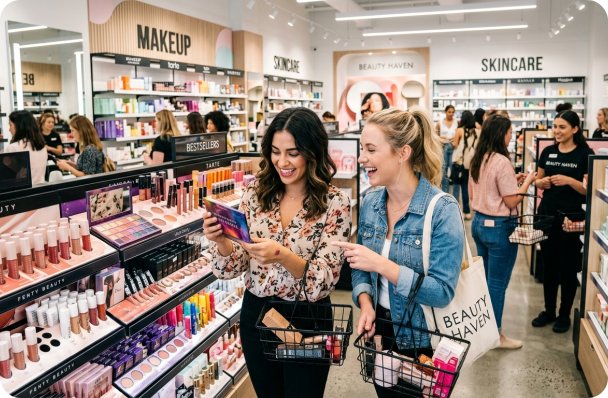
Walk into a drug store or a health and beauty retailer in 2026 and count the locked cabinets. Razors. Skincare. Perfume. Vitamins. Whole categories now sit behind plastic, with a buzzer for service and a wait time that most customers won't tolerate. The cabinets are doing exactly what they were supposed to do, which is reducing theft. They're also doing something LP teams rarely get blamed for, which is reducing sales.
Industry research has been making this point for a while. When honest customers can't easily reach a product, a meaningful share of them simply don't buy it. They go to a competitor. They order it online. They give up. Locked cabinets solve a measurable problem and create an invisible one. The lost-sale number rarely shows up in the LP scorecard, but it shows up on the P&L.
There's a different way to think about this category, and it starts with the question LP teams have been quietly asking for years: what if you could protect high-shrink product without locking it up?
Why health and beauty is uniquely hard
Health and beauty has a theft profile that doesn't look like grocery or apparel. Items are small. They're high-margin. They're often branded in a way that makes them resellable. They sit in dense aisles with limited staff coverage. And consumption-style loss (opening packaging in store, sampling, partial use) is harder to detect with traditional CCTV than smash-and-grab events.
The traditional response stack has three options. Lock the product up, accept the shrink, or staff up. Each one has trade-offs that hurt the business. Locking it up costs sales. Accepting shrink kills margin. Staffing up isn't realistic in the current labour market and doesn't scale across a national fleet anyway.
What visual AI changes for the
high-shrink aisle.
The capability that matters most for health and beauty LP isn't the dramatic full-cart pushout detection (although that's there). It's the quieter, more frequent stuff that adds up to most of your shrink:
In-aisle product interaction awareness
When an item leaves the shelf and never appears at checkout, the system flags it. That's the moment most LP systems miss entirely.
Shelf-edge concealment detection.
Bulk grabs, sweep theft, and concealment behaviours in known high-theft categories trigger real-time alerts to staff handhelds.
Consumption detection.
Packaging opened in-aisle, samples taken, products partially used and abandoned. This is hidden shrink that POS data can't explain.
Revisit alerts.
For health and beauty, repeat offenders are particularly damaging because the high-margin product moves fast on resale markets. GDPR-compliant, manually validated revisit lists let store teams know when someone with a confirmed history of theft has re-entered.
Self-checkout monitoring.
Missed scans, product switching, items in basket, partial payments. Soft nudges with a 91% compliance rate, so the customer self-corrects and your staff don't have to.
Major drug-store and health and beauty retailers across Europe and North America are using this kind of platform today. The deployment pattern looks similar across drug-store and health and beauty formats: existing CCTV stays in place, the AI overlays on top, alerts route to handhelds your staff already carry, and the data flows into the same dashboards LP and operations leadership are already looking at.
The unlock-the-cabinet conversation with merchandising
Once detection is in place at the shelf edge and at SCO, you have the data to start a different conversation with merchandising. Which categories are still genuinely losing the most? Which ones could come out from behind glass without a meaningful change in shrink? Where are honest customers walking away because of friction the LP team unintentionally created?
This is where LP becomes a revenue conversation, not a cost-control conversation. The retailers who get this right are the ones who use the data to selectively reduce friction, recover the abandoned sales, and shift the operating posture from defence to a more confident posture, where you know what's happening and you can respond proportionately.
What deployment looks like
This isn't a heavy lift. SAI's platform processes more than two million transactions a day across upwards of twenty thousand point of sale machines. Server deployment runs 1 to 2 days. Training period is 24 hours for checkout monitoring and around 3 weeks for full store-floor applications. Pilots run in 1 to 3 stores for 8 to 12 weeks. Most retailers see ROI inside 4 weeks of going live, primarily through SCO loss recovery and shoplifting reduction.
The platform is GDPR compliant by design, ISO 27001 certified, with strong governance around any feature that touches biometric data. For health and beauty retailers operating across multiple regulatory environments, this matters. The questions your DPO will ask have already been answered.
Where to start if you're an LP director in this segment
Pick the 3 stores where lost sales from locked cabinets feel the most painful. Run a pilot. Measure shrink against the baseline, but also measure category sales velocity, basket size, and the abandoned sale rate before and after. The full picture won't show up in the shrink number alone.
Locked cabinets aren't the only answer for health and beauty. They were a reasonable response when there was nothing better. There's now something better.
Lead magnet ideas
The hidden shrink in health and beauty: what your POS data isn't telling you
Focused on consumption loss, in-aisle concealment, and missed-scan patterns specific to drug-store and beauty formats. Walks through what visual AI sees that POS systems can't, with example detection scenarios and the operational follow-up each one enables. Aimed at the LP director who suspects shrink is higher than the books say but can't yet prove it.
The drug-store LP director's vendor evaluation guide: 12 questions to ask before signing
Companion piece to the AI Vendor Checklist that's already produced, but tuned for the specific use cases health and beauty LP teams care about most: shelf-edge detection, consumption loss, SCO monitoring on high-margin small items, GDPR posture, and integration with existing camera and POS infrastructure. Lets the LP director walk into vendor meetings with the right questions and a structured way to score the answers.