Why your self-checkout problem is actually an integration problem
Most grocery CTOs we talk to have already bought something to fix self-checkout shrink. Sometimes more than once. There's a weight scanner, an overhead camera array, a vendor who promised AI, and a dashboard nobody opens anymore. Loss is still happening. Finance still wants answers. And IT is the group that owns the unanswered ticket.
Here's what we keep noticing. The technology that detects missed scans isn't usually the bottleneck. The bottleneck is whether that detection can talk to your POS in real time, whether your existing CCTV can feed it without a hardware refresh, and whether your data team can pull the output into Snowflake or MicroStrategy without writing a custom pipeline. That's a CTO problem, not an LP problem.
What actually breaks at self-checkout
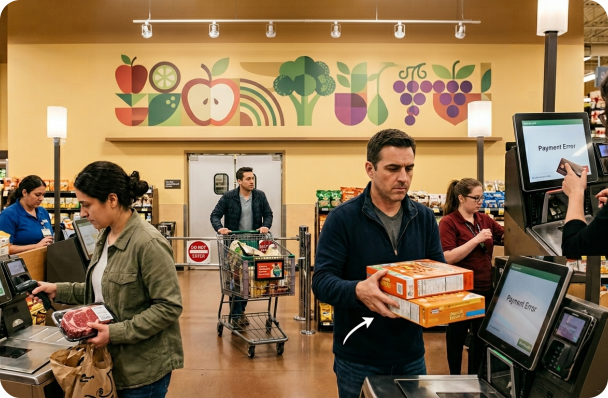
Grocery SCO has a specific failure pattern. Items get picked from the aisle and never appear in the transaction. Items get stacked and scanned as one. A cheaper barcode gets scanned while a different item goes in the bag. Payments don't complete. Carts get pushed past the gates without any scan at all. Each one is a small loss. Multiplied across thousands of daily transactions per store, the numbers get serious fast.
The traditional response was to add staff, lock down high-shrink items, or run a vendor's proprietary stack alongside your existing one. None of those scale. And the proprietary stack tends to bring its own GPUs, its own cameras, and its own data silo, which is where the integration problem really starts.
The integration questions that actually matter
If you're evaluating visual AI for self-checkout, these are the questions that determine whether it works in your environment or becomes another shelf-ware project.
Does it run on existing CCTV?
If it requires new cameras, the rollout cost balloons before you've prevented a single dollar of loss. Standard analog or IP feeds over RTSP should be enough.
Does it feed your data stack?
If the alerts only live inside the vendor's dashboard, you've created another silo. APIs that push events into Snowflake and surface in MicroStrategy mean LP data lives next to POS, staffing, and inventory data.
Does it require GPUs at the edge?
GPU-dependent systems have higher hardware costs, more failure points, and longer deployment timelines. CPU-based edge compute is faster to deploy and easier to support across a multi-store network.
Does it work with your VMS?
Milestone, IPConfigure, OpenEye are common. If the platform requires you to replace your VMS, walk away.
Does it integrate with your POS?
Off-the-shelf connectors for NCR, Flooid, and ECRS save you from writing the integration yourself. Overnight CSV feeds work for offline analysis. Live nudging requires API access.
Where do alerts land?
Zebra handhelds, iOS and Android devices, Vocovo headsets for hands-free, Tannoy for in-store audio. Alerts that show up in the systems your staff already use will get acted on. Alerts in a separate app won't.
What good looks like in production
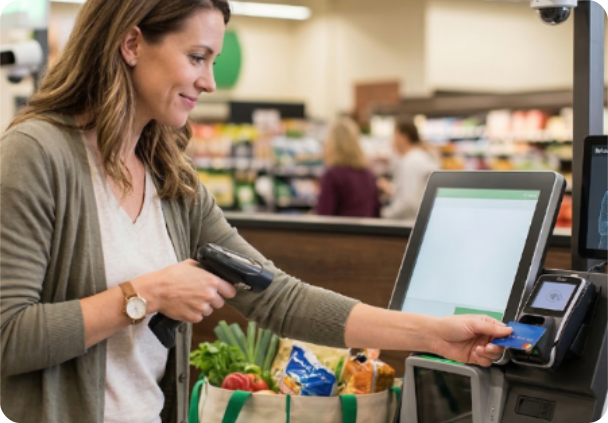
SAI's platform processes more than two million transactions a day across upwards of twenty thousand point of sale machines. The pattern that holds across those deployments isn't dramatic. It's quiet. Customers self-correct on around 91% of nudges, which means staff aren't being pulled into confrontation every few minutes. One camera covers multiple SCO terminals. Existing CCTV stays in place. The POS integration runs through the connectors you already have.
That last point matters more than it sounds. When the platform speaks the language of your existing systems, your team isn't writing custom middleware to make it work. Pilots run in 1 to 3 stores for 8 to 12 weeks. Server deployment takes 1 to 2 days. Most retailers see ROI inside 4 weeks of going live, mostly through self-checkout loss recovery.
What CTOs should ask in the first meeting
Skip the demo. Ask for the architecture diagram. Ask which VMS and POS systems are already integrated and where the friction has been on past deployments. Ask what the API surface looks like and whether you can pull events into your data lake without a paid professional services engagement. Ask about ISO 27001, SOC 2, and GDPR posture, because if you're rolling this out across grocery stores, the data residency and privacy questions will land on your desk before they land on legal's.
If the answers are vague, the integration is going to be vague. If the answers are specific and the vendor names actual systems they've connected to, you're probably looking at something that will deploy without becoming a 9-month project.
The bottom line for grocery CTOs
Self-checkout shrink is a business problem, but for IT it shows up as an architecture decision. The vendors who win in your environment are the ones who fit into the stack you already run, not the ones who ask you to rebuild around them. SAI was built to overlay onto existing camera and POS infrastructure, which is why deployments tend to look more like configuration than construction.
If you're being asked to evaluate a visual AI platform this year, start with the integration questions. The shrink reduction follows.
Lead magnet ideas
The grocery CTO's visual AI integration checklist
A 6 to 8 page gated PDF structured around the integration questions in the blog. POS, VMS, edge compute, alerting infrastructure, data pipeline, security and compliance. Each section has the question, the red flags, the green flags, and a place to score the vendor. Lets the CTO walk into a vendor meeting with a structured evaluation framework. High utility, opinionated, lets prospects self-qualify.
From pilot to production: a 90-day grocery SCO rollout playbook
Reference architecture plus a week-by-week timeline for a 3-store pilot. Includes the data flows (camera to platform, POS API to platform, platform to data lake), the integration points to test in each phase, and what 'ROI in 4 weeks' actually looks like in operational terms. Gives the CTO something concrete to pressure-test their internal team and any vendor against.